Frequently Asked Questions
Frequently Asked Questions: Appliance Repair Services in Winthrop, MA
When a household appliance breaks down, it creates immediate questions. Is it worth repairing? How long will it take? Why is it making that noise? At Appliance Repair Pros, we believe that an informed homeowner is a happy homeowner. We have compiled this extensive guide to answer the most common questions we receive from our neighbors in Winthrop, Revere, and East Boston. Whether you are dealing with a refrigerator that won’t cool in Point Shirley or a washing machine that won’t spin in a Cottage Park historic home, we have the answers you need.
This resource covers our general service policies, specific troubleshooting for major appliance categories, and detailed insights into the major brands we service. We want to demystify the repair process and help you understand the sophisticated machinery keeping your home running.
General Service and Scheduling Questions
Do you offer appliance repair service near me in Winthrop?
Yes, we are a locally focused business. Our primary service area includes the entire Winthrop peninsula, as well as the immediate neighboring communities of Revere and East Boston. Because we focus on this specific local area, we are not traveling from halfway across the state. This allows us to navigate local traffic patterns efficiently and offer prompt appointment windows to our neighbors.
How quickly can you fix my appliance?
Our goal is always to resolve the issue on the first visit whenever possible. We stock our service vehicles with a wide inventory of common failure parts, such as drain pumps, heating elements, igniters, and sensors for major brands. If your repair requires a specialized order, we utilize a network of local distributors to secure the component as fast as possible. We communicate the timeline clearly so you are never left guessing.
Is it worth repairing an older appliance or should I replace it?
This is the most common question we hear. The answer depends on the “50% Rule”: if the repair costs less than 50% of the price of a new machine, and the existing machine still has more than half of its expected life remaining, repair is usually the better financial choice. Older appliances often have robust build quality that newer, budget-friendly models lack. We provide an honest assessment of the overall condition of your unit so you can make a smart decision.
Do you work on gas and electric appliances?
Yes, we are fully qualified to service both gas and electric configurations. Whether you have a high-voltage induction cooktop or a gas dryer, we have the testing equipment and safety protocols to handle the repair. For gas units, we prioritize safety checks, including leak detection and carbon monoxide safety, during every service call.
What should I do before the technician arrives?
To help us diagnose and repair your unit efficiently, please ensure there is a clear path to the appliance. If you have pets, please secure them in a separate room for their safety and ours. For washing machines and dryers, try to remove any clothing inside. For refrigerators, you generally do not need to empty the food unless we specifically ask, but moving fragile items off the top of the fridge is helpful.
Refrigerator and Freezer Repair FAQs
Why is my refrigerator running but not cooling?
If the lights are on and you can hear the motor running, but the air is warm, the issue is often restricted airflow or a dirty condenser. Over time, dust and pet hair build up on the condenser coils, preventing the system from releasing heat. It could also be a failure of the evaporator fan motor, which circulates the cold air. In more complex cases, it may indicate a failure in the compressor start relay or the sealed system itself.
Why is there water leaking onto my kitchen floor?
Water pooling under a fridge is usually caused by a clogged defrost drain. When the fridge goes into its automatic defrost cycle, the melting ice drips down a tube to a pan underneath the unit where it evaporates. If that tube is blocked by food debris or ice, the water overflows inside the compartment and leaks onto the floor. It could also be a leak in the water supply line feeding the ice maker.
My freezer is cold, but the fresh food section is warm. What is wrong?
This is a classic airflow problem. Cold air is generated in the freezer and blown into the fridge section. If the evaporator fan fails, or if the air damper (a small motorized door) gets stuck closed, the cold air stays trapped in the freezer. Another common cause is a defrost failure, where ice builds up on the coils and blocks the air passages between the two compartments.
Why is my ice maker not making ice?
Ice makers are complex mechanical assemblies. Failure can stem from a frozen water fill tube, a defective water inlet valve, or a broken motor module. If you have a modern French door fridge, the ice maker compartment seal might be failing, allowing warm air in and causing the mechanism to freeze into a solid block. Changing your water filter regularly is also crucial, as a clogged filter reduces water pressure below the level needed to trigger the fill cycle.
Is a loud refrigerator noise dangerous?
It depends on the sound. A loud buzzing or clicking that happens every few minutes often indicates the compressor is trying to start but failing, which requires immediate attention to save your food. A high-pitched squeal or grinding noise usually points to a failing evaporator or condenser fan motor. While a fan failure isn’t an immediate fire hazard, it will eventually cause the cooling system to stop working.
Washing Machine Repair FAQs
Why is my washing machine not draining?
Drainage issues are the number one complaint with washers. This is almost always caused by a blockage in the drain pump filter (often coins, socks, or keys) or a kinked drain hose. If the path is clear, the drain pump motor itself may have failed. On modern machines, a “No Drain” error code will prevent the door from unlocking to avoid spilling water on your floor.
My washer shakes violently during the spin cycle. Is this normal?
Some vibration is normal, but violent shaking or “walking” across the room is not. This usually indicates an unbalanced load or the machine not being level. However, if it happens with every load, it likely points to worn suspension rods (on top loaders) or failed shock absorbers (on front loaders). In older machines, it could indicate the tub bearing is wearing out.
Why does my front load washer smell like mildew?
Front loaders seal tightly to prevent leaks, which can trap moisture and detergent residue inside the drum. This creates a breeding ground for mold and bacteria, especially in the rubber door boot seal. To prevent this, leave the door slightly ajar between cycles, use High Efficiency (HE) detergent, and run a monthly maintenance cycle with a dedicated washer cleaner.
What does the “Lid Lock” error mean?
Modern washing machines use a safety lid lock to prevent injuries during high-speed spinning. If the lock mechanism fails, or if the control board cannot verify that the lid is secure, the machine will not start. The lid lock is a common failure point that must be replaced to restore function.
Why is my washer filling with water but not agitating?
On top load washers, this often indicates a problem with the drive system. It could be stripped “dogs” (cams) inside the agitator, a broken motor coupling, or a failed shift actuator on newer vertical modular washers. The motor is running, but the physical connection to the drum has been broken.
Dryer Repair FAQs
Why is my dryer taking two or three cycles to dry clothes?
This is rarely a broken dryer; it is almost always an airflow restriction. If the hot, moist air cannot escape through the vent system, the moisture stays in the clothes. This can be caused by a clogged lint trap, a crushed flexible hose behind the dryer, or a blockage in the ductwork leading outside. Operating a dryer with restricted airflow is a fire hazard and shortens the life of the heating element.
My dryer gets hot but the drum won’t turn. What is broken?
This is typically a broken drive belt. When the belt snaps, the motor can still run, but the drum remains stationary. Most dryers have a belt switch that cuts power to the motor if the belt breaks, but some older models do not. It could also be a seized idler pulley or drum roller preventing rotation.
Why is my dryer making a loud squeaking or thumping noise?
Dryers utilize drum support rollers and idler pulleys to spin the heavy drum smoothly. Over time, the bearings in these wheels wear out, causing metal-on-metal squeaking or a rhythmic thumping sound. Ignoring this noise can lead to the drum rubbing against the cabinet, causing permanent damage to the machine or your clothes.
Do you repair gas dryers?
Yes, we specialize in gas dryer repair. Common issues include weak gas valve coils that open initially but fail once they warm up, or a broken igniter that glows but never lights the gas. We always perform a leak check on the gas connections after any repair to ensure your home safety.

Dishwasher Repair FAQs
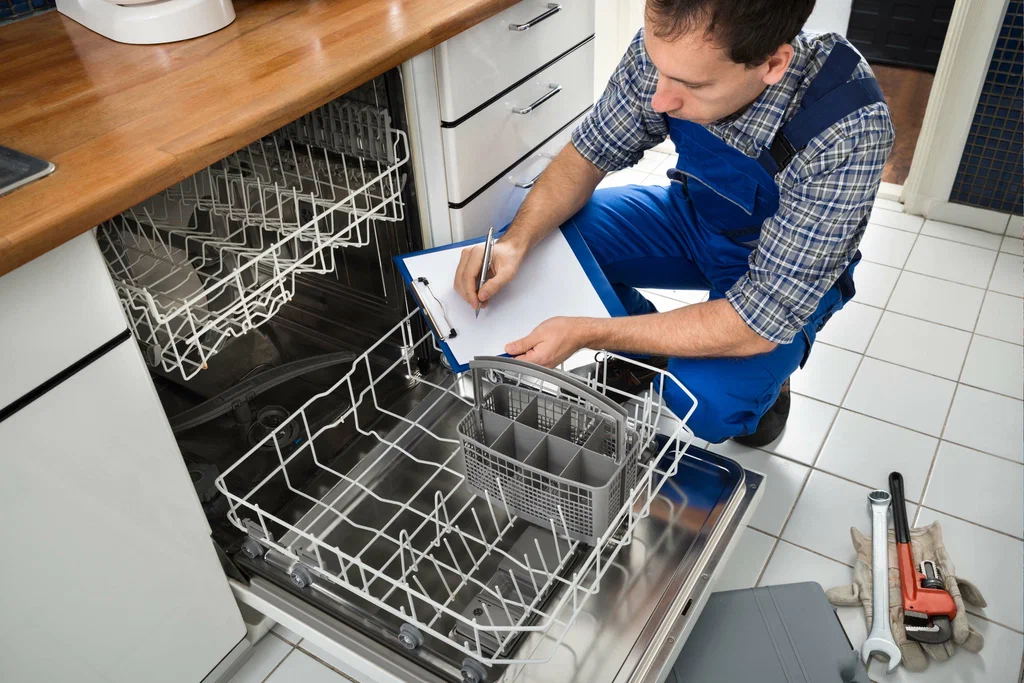
Why is my dishwasher not cleaning the dishes properly?
Poor cleaning performance is often due to water circulation issues. This can be caused by clogged holes in the spray arms, a blocked filter screen preventing water flow to the pump, or a failing circulation motor. It is also important to use a high-quality detergent and rinse aid, especially if you have hard water, to prevent mineral deposits from interfering with the wash chemistry.
Why is the “Clean” light flashing on my dishwasher?
A flashing light on the control panel usually indicates a specific error code. On many brands, a flashing “Clean” light means a heating error—the water did not reach the required temperature during the cycle. This could be a burnt-out heating element or a faulty high-limit thermostat. The machine stops the cycle to ensure sanitation standards are met.
Why is there water left in the bottom of my dishwasher?
A small amount of water near the filter is normal to keep seals moist. However, standing water covering the bottom of the tub indicates a drain failure. Check your sink’s garbage disposal (if connected) to ensure it isn’t clogged. Other causes include a blocked drain hose, a stuck check valve, or a failed drain pump.
Why is my dishwasher leaking from the door?
Door leaks are often caused by a worn or damaged door gasket. Over time, the rubber can become brittle or torn. Another common cause is the lower spray arm cracking, which can spray water directly at the door seal with enough force to push past it. Using regular dish soap instead of dishwasher detergent will also cause excessive sudsing and leaks.
Oven and Range Repair FAQs
Why is my gas oven not heating up?
The most common failure in gas ovens is the glow bar igniter. The igniter must get hot enough to draw a specific amount of electrical current; this current then opens the safety gas valve. As igniters age, they may still glow orange but fail to get hot enough to open the valve. Replacing the igniter usually solves the problem.
Why is my electric oven temperature inaccurate?
If your oven is burning food or taking too long to cook, the temperature sensor may have drifted out of calibration, or the control board may be failing. It could also be a hidden bake element that has burnt out, forcing the broiler element to do all the work (which leads to uneven cooking). We can calibrate the oven or replace the faulty heating components.
Why does my glass cooktop burner turn on and off?
On electric glass cooktops, the burners cycle on and off to maintain the set temperature. This is normal operation. However, if the element stays off for too long and food stops cooking, or if it stays on high regardless of the setting, the “infinite switch” behind the control knob has likely failed and needs replacement.
My self-cleaning oven door is stuck locked. What do I do?
The self-clean cycle uses extremely high temperatures, and the door locks for safety. If the cycle is interrupted or the cool-down phase malfunctions, the latch motor can get stuck in the locked position. Do not force the door open, as you will break the glass or the latch. We can manually release the latch and troubleshoot the sensor or motor that caused the lockout.
Brand-Specific FAQs
Do you service Samsung and LG appliances?
Yes, we are highly experienced with these tech-forward brands. Samsung and LG appliances use advanced components like Linear Compressors and Direct Drive motors that differ from traditional American designs. We have the specific diagnostic tools and software knowledge to troubleshoot their complex control boards, ice makers, and sensor arrays.
Do you repair Whirlpool, Maytag, and KitchenAid?
Absolutely. The Whirlpool family of brands (which includes Maytag, KitchenAid, Amana, and JennAir) represents a large portion of the appliances in Winthrop homes. We are experts in their specific technologies, such as the VMW washing machine drive system and the Jazz board defrost controls found in their refrigerators. These are generally very repairable machines with excellent parts availability.
Do you work on European brands like Bosch and Miele?
Yes, we provide specialized service for European brands. Bosch and Miele appliances require a different approach due to their unique engineering—such as condensation drying in dishwashers and heat pump technology in dryers. We understand the tight tolerances and safety systems (like AquaStop) that make these premium appliances unique.
Do you service GE and Kenmore appliances?
We service the full lineup of GE appliances, including the Profile, Café, and Monogram series. We are also experts in Kenmore repair. Since Kenmore appliances are manufactured by other companies (Whirlpool, LG, Frigidaire), our first step is identifying the original manufacturer code to ensure we follow the correct diagnostic path and source the exact OEM parts needed.
Can you fix Sub-Zero or Thermador appliances?
Yes, we handle high-end, built-in refrigeration and professional-style ranges. We understand that these units are often integrated into your cabinetry and require extreme care during disassembly. We focus on preserving the value and performance of these significant investments.
Safety and Emergency Questions
I smell gas near my stove. What should I do?
Safety is the priority. If you smell a strong odor of gas, do not attempt to operate the appliance or any light switches. Turn off the gas supply valve behind the unit if it is accessible. Open windows to ventilate the area and leave the home immediately. Contact your gas utility provider from a safe location. Once the immediate danger is cleared by the utility company, contact us to find and repair the leak within the appliance.
My microwave is sparking. Is it safe?
Sparking inside a microwave (arcing) can be caused by metal objects, but it can also be caused by a burnt waveguide cover or a failing stirrer motor. Stop using the microwave immediately. Continued use can damage the magnetron tube, which is the heart of the machine. Unplug the unit and reach out to us for assistance.
My dryer smells like it is burning. What is happening?
A burning smell from a dryer is a serious warning sign. It often indicates that lint has built up near the heating element or motor, or that the belt is slipping and creating friction. Stop the dryer immediately and do not use it until it has been inspected. Lint fires are a real danger, and this symptom should never be ignored.
Maintenance and Prevention
How often should I clean my dryer vent?
We recommend having your dryer vent ducting professionally cleaned at least once a year. If you have a large family or do laundry daily, you may need it more often. In Winthrop, where humidity can be higher, lint can clump more easily. A clean vent reduces drying time, lowers energy bills, and drastically reduces the risk of fire.
How do I prevent my front load washer from smelling?
Moisture control is key. After every load, wipe down the door gasket and the inside of the glass. Leave the door slightly ajar when the machine is not in use to allow air circulation. Run a “Tub Clean” cycle with a specialized washing machine cleaner tablet once a month to break down detergent residue and kill bacteria.
Do I need to clean my refrigerator coils?
Yes, absolutely. The condenser coils are responsible for releasing the heat pulled from your food. If they are covered in dust and pet hair, the compressor has to work twice as hard to cool the fridge. We recommend vacuuming the coils (usually found at the bottom or back of the fridge) every six months to extend the life of your compressor.
Does hard water affect my appliances?
Yes, mineral buildup from hard water can affect the performance of dishwashers and washing machines. It can clog spray arms, coat heating elements, and damage inlet valves. If you notice white film on your dishes, we recommend using a rinse aid and occasionally running a cycle with a citric-acid based cleaner to break down the lime scale.
Contact Us
We hope this FAQ has been helpful. If you have a specific question not answered here, or if you are ready to schedule a repair, please do not hesitate to contact us. At Appliance Repair Pros, we are dedicated to providing the highest quality service to our Winthrop community. Reach out to us for assistance today.
